
Each week we bring to you a discussion on the latest trends in digital marketing and how you can actually implement these strategies into your organization.
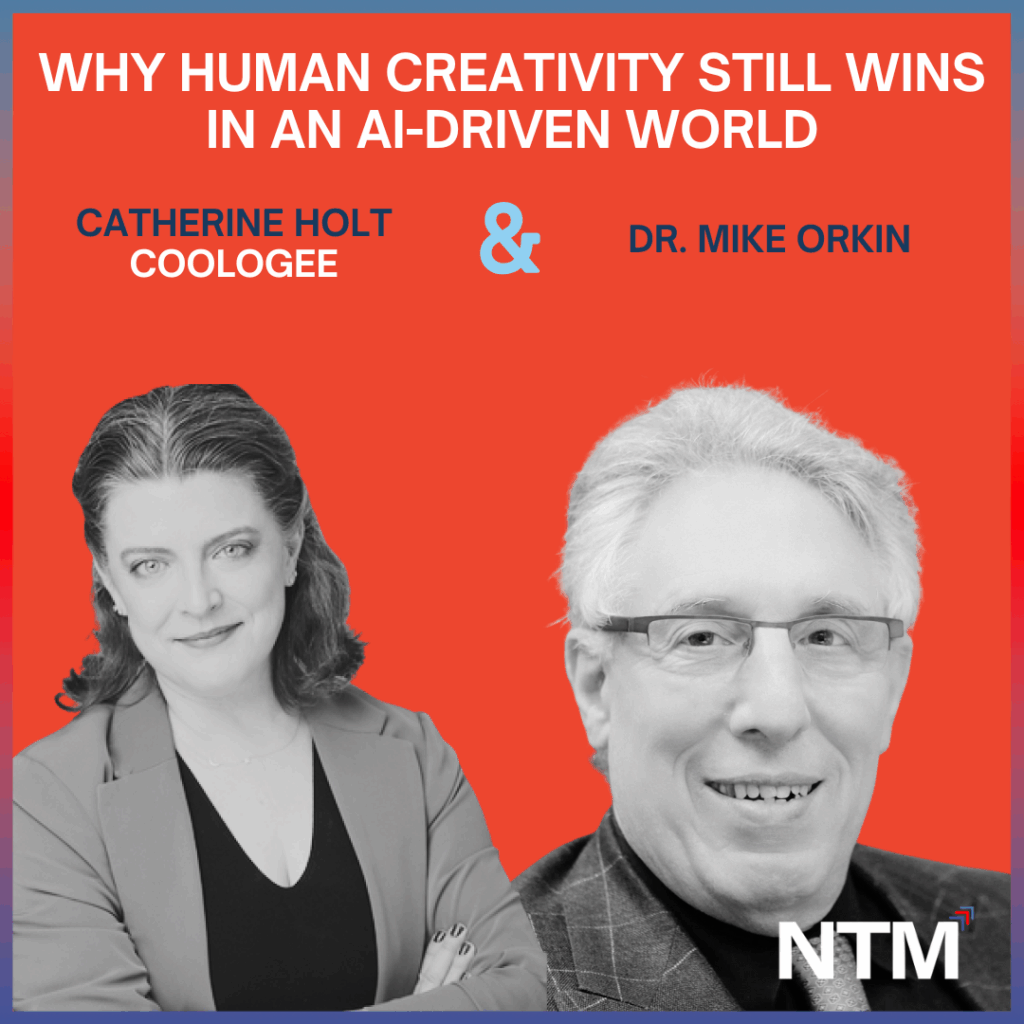
Welcome to another deep dive into the world of marketing, strategy, and AI innovation! Today we’re exploring the engaging conversations from Episode 162 of the NTM Growth Marketing Podcast, hosted by Andrew. We had the pleasure of hosting Catherine Holt, founder of Coologee and brand strategy expert, followed by Dr. Michael Orkin, statistician, author, and educator. Together, their stories shape a broad, lively, and absolutely relevant snapshot of what it means to build brands, adapt to new technologies, and navigate an increasingly AI-driven world.
If you’re a marketer, entrepreneur, educator, or just curious about how chance, randomness, and technology impact your life and work, this post is for you. Grab a coffee, settle in, and let’s break it all down — from the human side of brand building to the creative chaos of AI and statistical thinking.
Catherine Holt is a brand strategist, veteran marketer, and founder of Coologee. With over 25 years in the industry, Catherine’s journey is a patchwork of agency life, in-house transformation at giant corporations like Progressive Insurance, and entrepreneurial ventures. Driven by change, curiosity, and creativity, Catherine refers to herself as a “beast horse of a different color” — an apt description for someone who never stops asking, “what’s next?”
“I like change and I like it to happen fast… I’m really well suited for coming in and helping organizations do something they’ve never done before.”
If you’ve ever felt boxed in by routine or corporate inertia, Catherine’s story is a breath of fresh air. Her drive is all about moving quickly, experimenting boldly, and always putting humanity back into the business equation.
At Coologee, Catherine and her team believe brand is misunderstood. It’s not just a logo or campaign — it’s a massive business asset that’s often managed with less strategy than it deserves.
What sets Coologee apart:
Coologee works with clients to “prove that brand is business and to show in what way and how.” Their methodology: start from core values, human touch, and authentic stories. From there, build everything else — campaigns, digital platforms, and growth strategies.
Transitioning from agency to in-house at Progressive was a pivotal moment for Catherine. She led a wave of change inside a Fortune 500 environment. The biggest lesson? Corporate structure can slow the pace of innovation:
Catherine reflects on her time at Progressive:
“I had accomplished a lot of change, but… the idea of just continuing to do the same thing felt like I was missing something.”
That hunger for novelty led Catherine back to entrepreneurship, where she could pilot new strategies quickly — and help clients leapfrog the competition without slogging through unnecessary bureaucracy.
Insurance marketing has a reputation problem. Many people picture the “mobster guy” pitching fear — the classic, “You never know what could happen…” To stand out, Catherine’s client needed a total reinvention.
Case Study: Can Do Insurance & Can Do Financial
With Catherine’s help, they designed a fully integrated lead aggregator platform that reduces lead cost, prioritizes human connection, and uses digital tools the smart way.
Industry challenge:
Coologee’s solution:
“By putting the brand first, telling a story that feels more human, we’re able to make a difference. We’re breaking through and we’re getting leads.”
Catherine’s approach flips the script — proving you don’t have to be the biggest player to win. The key? Make it easy, make it real, and actually care about your customer’s story.
How do you sell complex products like insurance (or finance, tech, or healthcare) when most people feel out of their depth?
Common customer challenges:
Catherine stresses a radically simple approach:
“Don’t forget your humanity when you’re having a conversation with a prospect or a customer and treat it with respect, because that’s what it deserves.”
Forget aggressive tactics; real marketing builds trust, clarity, and long-run relationships.
Catherine is refreshingly candid about her experience with ADHD:
“ADHD loves AI… I feel like we were uniquely created for this crazy world that we’re navigating.”
AI has become a power tool for marketers willing to experiment. It lets you:
But — as Catherine highlights — it’s not all magic. Human oversight is critical. You need to:
“AI can help us get to a destination faster… but it’s not without some kind of oversight.”
A major takeaway: AI disrupts knowledge-driven businesses fastest. The organizations that thrive will combine digital speed with human accountability, not replace real people with machines.
It’s easy to geek out on AI if you’re an innovator — but not everyone is on board. Catherine references Geoffrey Moore’s classic framework, “Crossing the Chasm,” to explain adoption waves:
“The things I love about AI are probably still scary for a lot of people. So we’re applying change management, psychology, and training to make it accessible.”
Coologee now focuses on change management — designing products and training environments that help users cross the adoption gap. True organizational change comes when people stop dabbling and start using AI to shift real workflows.
AI wins when it’s not just cool — but mandatory and deeply embedded in your processes.
Second and third movers—not the first—often become market leaders in new tech. Steady, thoughtful implementation beats rushing in and burning out.
The podcast dives into a tricky double whammy: remote work and AI adoption.
Catherine urges companies to actively plan how to nurture young talent:
“With AI adoption, it’s going to put the onus on companies to bring the next generation along… So that’s going to be a really interesting management challenge.”
This is a human problem, not just a tech one. You can automate tasks — but you can’t automate wisdom.
Catherine’s segment transitions into the second guest, Dr. Michael Orkin — a lively statistician, educator, and author. If you ever doubted the power of randomness in everyday life, Dr. Orkin’s story will change your mind.
Dr. Orkin’s backgrounds:
Life isn’t just about data — it’s about finding stories in the numbers.
Dr. Orkin’s move to Substack was inspired by simplicity and curiosity. Substack is now one of the web’s hubs for tech-forward, early adopter audiences — mirroring the podcast’s own vibe.
He shares insights and fun facts about probability:
“If I could characterize my book in one or two words, it’s a book about randomness in everyday life.”
Statistical ideas, told without heavy math, are suddenly inviting for regular readers.
Book marketing looks nothing like it did 20 years ago. Forget expensive ads in the New York Times — today’s authors are building presence online:
Dr. Orkin’s toolkit:
“I’m thinking about trying to get a bigger publisher… But right now I get to do my own types of marketing.”
Self-publishing is empowering, but it also means becoming your own marketing department. It’s a high-energy, DIY world — and tech tools make it possible. Even the book itself started as a textbook and morphed into a regular-people-readable guide to randomness.
Dr. Orkin admits he’s “a terrible artist” — but that hasn’t stopped him from illustrating cartoons for his Substack. The secret? AI drawing tools (via ChatGPT 5.0 and prompt engineering).
Step-by-step, he trades text prompts with AI to create unique cartoons that breathe life into his posts. No art degree required.
AI unlocks creativity for non-artists.
“I asked [AI] to do a drawing, and it was amazing. It came up with this great cartoon… So now it’s opened this door of creativity for me.”
Readers love visuals. It’s no longer a barrier if you can’t sketch — the prompt is your brush.
Tech is transforming classrooms and test-taking equally:
Dr. Orkin’s take?
“If they learn how to use AI, why not learn now? Nothing you can do to stop them.”
Real-world skills are about knowing the right questions to ask, not just memorizing answers.
Despite all the noise about AI, productivity, and online expansion, both guests circle back to human connection:
The challenge — and opportunity — for marketers, educators, and innovators is keeping human connection at the center of digital transformation. Smart tech should amplify our curiosity, empathy, and creativity, not erase them.

Explore our archive of NTM’s original podcast, The School for Humanity, created to discuss the greatest challenges humanity faces and help promote those who are helping to find solutions.
“We learn best and perform best in environments that are supportive, enriching, and light giving. Based on what’s called …
“I always say that nothing in business defies logic, so if you look at business logically and think things …
“AlliancesHub came out of a concept that in life we need to have resources around us to be able …
“For me, leadership is when you have someone that cares deeply about those they influence, that trusts those that …
“I created the Intrapreneurs Influence Lab to really bring the best of what I have learned and to teach …
“Why aren’t we doing this? Why haven’t we done this? Why not create a school of fish that’s bigger …
“Pre-Week Planning is the process, it is the habit, that will empower someone to schedule their priorities rather than …
“If you are not aligned with who you are and what you stand for and how you want to …
“I realized that we as a society have lost some of this innate affinity for storytelling. That it’s not …
“When you spend that amount of time with somebody on this intimate platform, and I do think podcasting is …
“Why would anybody do this by choice? Number one reason over and over and over again is not money, …
SFH # 169 Reducing Screen Time with Tommy Sobel “I made an extreme transformation in my life, and I …
SFH # 168 Functional Medicine with Dr. Ann Shippy “I went to med school so that I could do …
SFH # 167 Thinking Time with Achim Nowak “I believe that all business success in the end, and I’m …
SFH # 166 Connecting Water to the Internet with Samuel Ian Rosen “Water is actually something that is financeable. …
“The Runga mission has really evolved quite a bit. It’s very much exploring this mindful side of everybody that …
“The more somebody takes care of themselves the higher they’re actually going to be in terms of productivity and …
“You have to keep yourself focused on what you want to do. And you’ve got to keep your vibe …
“Our goal is to impact a million lives through better business, and we can do that through influencing the …
“I realized that breathing patterns are a reflection and an expression of our relationship to our body, to each …
“You have these currents. You have this human power, this power shift of humanity that’s happening, you have this …
“Leadership is mostly about caring about people and caring about something more than yourself. So the passion comes from …
“The key to really making change, lasting change, is to start with where you can actually affect change, and …
SFH # 166 Connecting Water to the Internet with Samuel Ian Rosen “Water is actually something that is financeable. …
“I think we’re all in this place of trying to find our way of navigating what has been happening, …
Moe Carrick believes that people can and should thrive at work, and that when they do, organizations succeed. With …
Steven Piersanti is founder of Berrett-Koehler Publishers, Inc., a leading independent publisher that pursues its mission of “Connecting People …
Masami Sato is a social entrepreneur, CEO and founder of the global giving initiative, Buy1GIVE1 (B1G1). She is also …
Maggie loves working with leaders, teams, and organizations to maximize collaboration and communication so they can do their best …
Bill Torbert received a BA in Political Science & Economics and a PhD in Administrative Sciences from Yale University. …
Connie Benjamin is a Story Archaeologist, Master Interviewer, #1 International Best Selling Author, and international speaker. She is on …
Cameron is a researcher, writer, entrepreneur and the founder of TRU KAVA, a company that is striving to set …
Rob Sinclair believes in T. Harv Eker’s maxim that “how you do anything is how you do everything.” This …
Joel Malkoff, a.k.a. the Ethics Giver, demonstrates that ethical business decision-making isn’t just the right thing to do—it’s the …
Forrist, co-founder of Planetary C.A.R.E. is a researcher, synergist and strategist, working in the areas of blockchain, multi-stakeholder collaborations …
Dr. Brian Underhill is an industry-recognized expert in the design and management of worldwide executive coaching implementations, and a …
Catherine Rocheleau is a three-time best selling author, award winning leader and Business Impact Strategist who is passionate about …
Nilima Bhat is a facilitator of personal transformation, coaching individuals and organizations in their quest for conscious evolution. She …
Allison Maslan, CEO of Pinnacle Global Network, is the Wall Street Journal Best Selling Author of Scale or Fail. …
Sally Helgesen, cited in Forbes as the world’s premier expert on women’s leadership, is an internationally best-selling author, speaker …
Mitchell Hora is a 7th generation Iowa farmer and the founder/CEO of Continuum Ag. His passion with farming started …
A Dutch rocket scientist, shaman and entrepreneur, co-founder of Tribepreneurs Mastermind Groups and founder of the Awaken & Connect …
Innovation expert Chuck Swoboda is a pioneer in the LED lighting industry, and has over 30 years of experience …
Tony Saldanha is a globally recognized expert and thought-leader in Global Business Services and Digital Technology. Tony is currently …
Stu is the author of the acclaimed book The Law of Small Things: Creating a habit of integrity in …
Captain John “Coach” Havlik, U.S. Navy SEAL (Retired), led special operations teams around the world during his 31-year naval …
Michael C. Fillios is the founder and CEO of the IT Ally Institute, a nonprofit organization providing small and …
Jeff Hays has been a filmmaker since the late nineties and is known for Fahrenhype 9/11 (2004), a response …
Kevin Jones is an eight times successful serial entrepreneur who co-founded the world’s largest social enterprise and impact investing …
Barbara is a master voice coach, author, keynote speaker, and singer/songwriter who merges lessons from 12 years in organization …
Leonard A. Schlesinger is Baker Foundation Professor at the Harvard Business School where he serves as Chair of the …
Jerry Power has over 30 years’ experience in strategic marketing and business analysis in the communications industry. Jerry is …
Bob Kaplan founded Kaplan DeVries Inc in 1991. Before that, he spent twelve years at the Center for Creative …
Autumn Fladmo Smith is the co-founder of Paleovalley and Wild Pastures, holds a Masters in Holistic Nutrition, a Certified …
Ken Sandy is a 20+ years veteran in technology Product Management. Ken pioneered and teaches the first Product Management …
Paula Alexander is the Sr. Director of Sustainability, at The Clorox Company, leading the Sustainability Center Commercial Team and …
Dan Bruder is the CEO of Fusion Dynamics Group, an international strategy and leadership consulting firm. He is also …
Howard Ross is lifelong social justice advocate, and is considered one of the world’s seminal thought leaders on identifying …
Dr. Mariza Snyder is a functional practitioner, women’s health expert and the author of seven books: The #1 National …
Dr. Patrick Gentempo, Jr. is the co-founder and CEO of Action Potential Holdings, Inc., and the author of the …
Dr. Daniel Pompa is a respected researcher, author, podcast host, and teacher. He specializes in root cause, inflammation-driven disease, …
By accessing inner wisdom through intuitive intelligence, Therese Rowley has facilitated business leaders’ once-in-a-lifetime breakthroughs, helping them make powerful …
Kim Cameron is the William Russell Kelly Professor of Management and Organizations in the Ross School of Business and …
Alison Callan believes we all have infinite potential, that we are creative, resourceful and whole. As an award winning …
Dr. Chris Wedding is a former private equity investor, startup founder, professor, investment banker, and teacher with over a …
Kathy Caprino spent 18 years in corporate life. In the beginning, she found this career path exciting and rewarding, …
Juana Bordas emigrated to the U.S. from Nicaragua on a banana boat when she was four. The youngest daughter …
Ben Azadi is on a mission to help 1 billion people live a healthier lifestyle. Ben is the author …
Johann Nogueira has spent his entire career solving problems and fixing businesses. He discovered the power of systemization and …
For over 30 years, Dan Tobin has been a thought leader, an innovator, and a consultant steadfastly applying the …
The opening line of a recent article written by today’s guest, Jack Nasher, is “when parties sit down to …
Susan Hunt Stevens founded WeSpire in 2010 and has led the expansion of the company from the leading sustainability …
After graduating with a Masters in Professional Accounting (MPA), Zach Weismann took a job with one of the Big …
Amy Posey is a Silicon Valley-based leadership consultant focused on neuroscience and high performance. As both an adventurer and …
Alex Gershenson and SupplyShift co-founder Jamie Barsimantov, both PhDs in Climate Science and Environmental Economics, founded SupplyShift to support …
Visioneer Frank Fitzpatrick believes in the transformative power of music and creativity to optimize human potential, inspire us, and …
In her book Delusional Altruism, author and consultant Kris Putnam-Walkerly provides real-world advice and practical guidance to help philanthropists …
As the Director of Business Development at DoSomething Strategic, Mary Noel believes that there is massive potential at the …
In 1998, Drew Dumsch founded The Ecology School to transform how people think about science, food, the environment, and …
What if your values created much more business value? What if they changed customer choices, enhanced employee engagement, increased …
Dune Ives is the Managing Director of award-winning Lonely Whale, where she designs and leads initiatives that address environmental …
As the founder and CEO of Business for America, Sarah Bonk is on a mission to strengthen representative democracy. …
Dr. Matthew Sleeth was at the peak of his career, an ER physician and chief of staff of his …
Gexsi stands for Global Exchange for Social Investment. The search engine works like a platform that connects innovative social …
As a certified B-Corp corporation, SES is a values based, mission driven company. A company that inspires while making …
Models of Impact is a role-playing and ideation game that makes it easy to generate new and sustainable business …
XCHG ingests data sourced from each commodity’s lifecycle and converts it into Intelligent Commodities™, digital assets that enable …
Based in Brazil, Movin uses smart materials to offer timeless fashion with the environment in mind. In this …
Near Me is a customizable marketplace solution powering the sharing economy. Global brands and Entrepreneurs now have a …
HEX Ferments uses the traditional method of fermentation to preserve and transform local, organic produce into nourishing foods. Their …
As a B Corp Certified Corporation,OORR has a mission of creating performance that is good for the planet. Using …
Since 2008, GreenStep has worked to help businesses increase their profits while improving their sustainability performance. Spearheading their goal …
Did you know that it can take 3000 litres of water to make just one cotton t-shirt? There are …
As Co-Founder and Global Strategy Director of 5 Gyres, Anne Cummins has made it her mission to help reduce …
When Paul grew tired of collecting litter and garbage from single-use shopping bags, balloons, styrofoam, discarded plastic food packaging …
Since founding Berlin Organics in 2015, Klaas Koolman has been providing contemporary organic foods. His company has made it …
As Chief Executive Officer at D-Orbit, Luca Rossettini and his team are on a mission to provide end-to-end solutions …
Since 2008 4 Pines Brewing has worked to restore fun in people’s lives by following their core values of …
Since it was founded in 2007, Eosis has provided environmental advice, which could lead to a more efficient way …
Since childhood Tara Teipel has been driven to finding the truth through spiritual ritual. After 25 years of traveling …
Author and educator, Chris Allison knows about the world of entrepreneurship. For 16 years — Chris led Tollgrade Communications …
Each year the rates and costs of chronic disease are rising globally. While these increases are hard on the …
Since 2002 Co-op Power has raised more than $320,00 in Member Equity, $840,00 in member loans and $850,000 in …
Since 1966, Caesars Entertainment has made it their aim to provide the world with the most geographically diversified casino-entertainment …
If humanity has changed the world by mistake, can we change it with intent? That is the question Interface …
At The School for Humanity, we believe that when people work together for good, amazing things can happen. By …
Did you know that the average person uses 185 pounds of plastic each year? Much of this plastic waste …
If you are listening to The School For Humanity, you probably care about making a positive impact on our …
RF Binder believes that business can be a force for good. In this interview, we chat with Annie Longsworth …
Every house is different, but nearly every home can become significantly more energy efficient by at least 20%. Thanks …
Would you believe that the average American contributes to over 130 pounds of landfill waste per month? Unfortunately, …
In this episode of The School For Humanity, we chat about how Goodvertising started as an idea, turned into …
Did you know that there are over 2.5 billion people don’t have access to clean water, and 5 million …
Advancing systems and solutions by design since 2004, evolveEA is a nimble multidisciplinary practice that involves both sustainability and …
Serving as a bridge between brand innovators across a variety of circles, Sustainable Brands creates a forward-thinking space for …
Did you know that only 1% of plastic is recycled at a global level and 50% of plastic is …
Embracing a holistic approach, Enviro-Stewards has created environmental and economic sustainability solutions to help businesses alleviate ongoing resource and …
If you are seeking animal-related experiences as a volunteer, or a part of your life mission is related to …
Did you know that 85% of a company’s value today is made up of intangible assets? Learning more about …
Bringing together a diverse community of stakeholders, GreenBlue encourages innovation and best practices to promote the creation of a …
Approaching the possibilities and problems of marketing and sustainability from a cultural perspective, The Soap Group helps organizations understand, …
Wearing many hats as the Founder and CEO of ArgoNox, Sarah Mishek shares how she is creating a forward-thinking …
In this episode of The School For Humanity, we chat with Greg Evans – the owner of Seeds Training. …
Emerging from the grassroots up to solve today’s biggest challenges, Shareable is an award-winning news, action, connection hub for …
As of the recording of this episode, there are over 46 million hungry Americans. Hunger is a widespread issue …
Built on the values of trust, innovation, partnership, and performance, Patsy Doerr leads Thomson Reuters as the Global Head …
It can be agreed that reading is a very important skill to master, right? In this episode with the …
As an award-winning certified B Corp, a Certified Sustainability Professional, and PhD graduate in sustainability from the University of …
Creating the first stainless steel, BPA-free, reusable water bottle in 2004, Klean Kanteen had a vision to create a …
According to the World Health Organization, nearly 4 million people die prematurely every year from illnesses including cancer caused …
Imagine that you could enjoy the sweetness of both donuts and a healthy lifestyle. Built on the foundations of …
By changing people’s minds and behaviors in addition to offering new sustainable options to reduce the use of harmful …
As more people are becoming increasingly interested about why brands and organizations exist, what they stand for, how they …
In this conversation with Geoff Kendall, the CEO of Future Fit Business, we discuss how the traditional business models …
From their spacecrafts to their APIs, Andrew Zolli shares how his company, Planet, services the largest fleet of Earth-imaging …
How amazing is it that we can illuminate a room with a flick of a light switch? Now, imagine …
As a nonprofit, Effie Worldwide helps businesses grow and connect with their audience to improve how their messages are …
Imagine that you had 200 chances to make a greener choice, every single day. How? With each product that …
In this episode, we had a chance to learn about how Mission Edge makes business processes easier for nonprofits …
Similar to the vision for The School For Humanity, the “triple bottom line” of sustainability as a foundation for …
What started out as finding a way to brew their own beer in college, turned into a delicious adventure …
When it comes to doing business for good, BEST knew that this included creating preventative measures to end human …
Have you ever wondered how you could help the Refugee families that come to the United States? In this …
In this conversation with the Founder of 4P Foods, Tom McDougall, we discuss the importance of businesses being responsible …
Based in Atlanta, USA Shelley Saxena founded the company, Sevamob with the mission is to fundamentally transform the delivery …
After a life-changing experience in Nairobi, Because International Founder Kenton Lee was inspired to design and create a shoe …
Twenty-three jobs later, CEO of edovo Brian Hill shares why he was inspired to make a positive impact on …
In this episode, we chat with the Co-Founder of Plant Power Fast Food about how a vegan lifestyle impacts …
As a child, Executive Director of Impact Business Leaders David Kyle wanted to be a baseball player. Fast-forwarding to …
Have you ever thought about what people would say at your funeral? In this episode, Bryan Pape dives into …
In between rock climbing, traveling, and salsa dancing with her husband and their baby, Sophia Mendelsohn was an inspiration …
With the vision to increase availability certified sustainable seafood across the region, the Marine Stewardship Council appointed former commercial …
If you have ever been lucky enough to participate in an eco-friendly foam party, you have probably heard of …
As an expert in Gen Z marketing, Marissa Ranalli manages and grows integrated partnerships with young people platforms, such …
As a platform created to discuss the greatest challenges humanity faces and help promote leaders who are helping to …
As a selected Global Leader of Tomorrow by the World Economic Forum, Founder of SheEO Vicki Saunders has spoken …
Have you ever had a random phone call that changed your life? After multiple reschedules, Annie and Anna were …
Saving pandas, creating free health clinics and increasing renewable energy in addition to positively affecting 10 million people around …
As a self-proclaimed “nature nerd”, Janine Benyus, is the Co-Founder of the Biomimicry Institute (a non-profit dedicated to making …
Welcome to another episode of The School For Humanity where we connect with Andrew Yang about how he is …
As a PhD candidate and committed impact entrepreneur, Dr. Gavin Armstrong shares his vision to alleviate iron deficiency around …
Imagine what a difference it would make if more people felt safe, connected, and empowered to live into their …
As senior Vice President of Americas at Cathay Pacific Airways, Philippe Lacamp is creating a vision to build the …
Today we have Scott Steele from EVE Encinitas on The School for Humanity. Eve Encinitas, located in North …
Did you know that over 600,000 tons of vinyl from banners and billboards end up in landfills each year? …
Today on The School for Humanity, we’re speaking with author, mentor and entrepreneur Melissa Ambrosini. Melissa talks about her …
Today on The School for Humanity we’re speaking with Lindsey Bolton who is the Community Rockstar at All Good. …
Today on The School for Humanity we’re talking to Kate Williams, the CEO of 1% for the Planet. 1% …
After studying business and knowing she didn’t want to work in a traditional corporate setting, Kelsey started her career …
This week on The School for Humanity we’re speaking with Ali McMutrie who is the Co-Founder and Co-President of Haitian …
Chuck Samuleson has worked in the food industry all his life. During that time, he saw food trends come …
Today’s School for Humanity podcast features Richard Leftley, the founder and CEO of Microensure. By providing insurance to lower …
This week on The School for Humanity we have Rachel Sumekh who is the CEO of Swipe out Hunger. …
Learn to read, then read to learn. That’s what Ann McCormick’s mantra has been since starting her first company …
From the Wolf of Wall Street to meditation guru, Tom Cronin’s career path has been anything but traditional. In …
 | Thank you for Signing Up |